Decision tree vehicle purchase outcomes and simplification
2025-familiarisation-se-q07 · Multipart · 4 marks
Source: NESA 2025 HSC Software Engineering Familiarisation Q7
Question
Consider the following decision tree of a trained machine learning model that determines whether to purchase a vehicle.
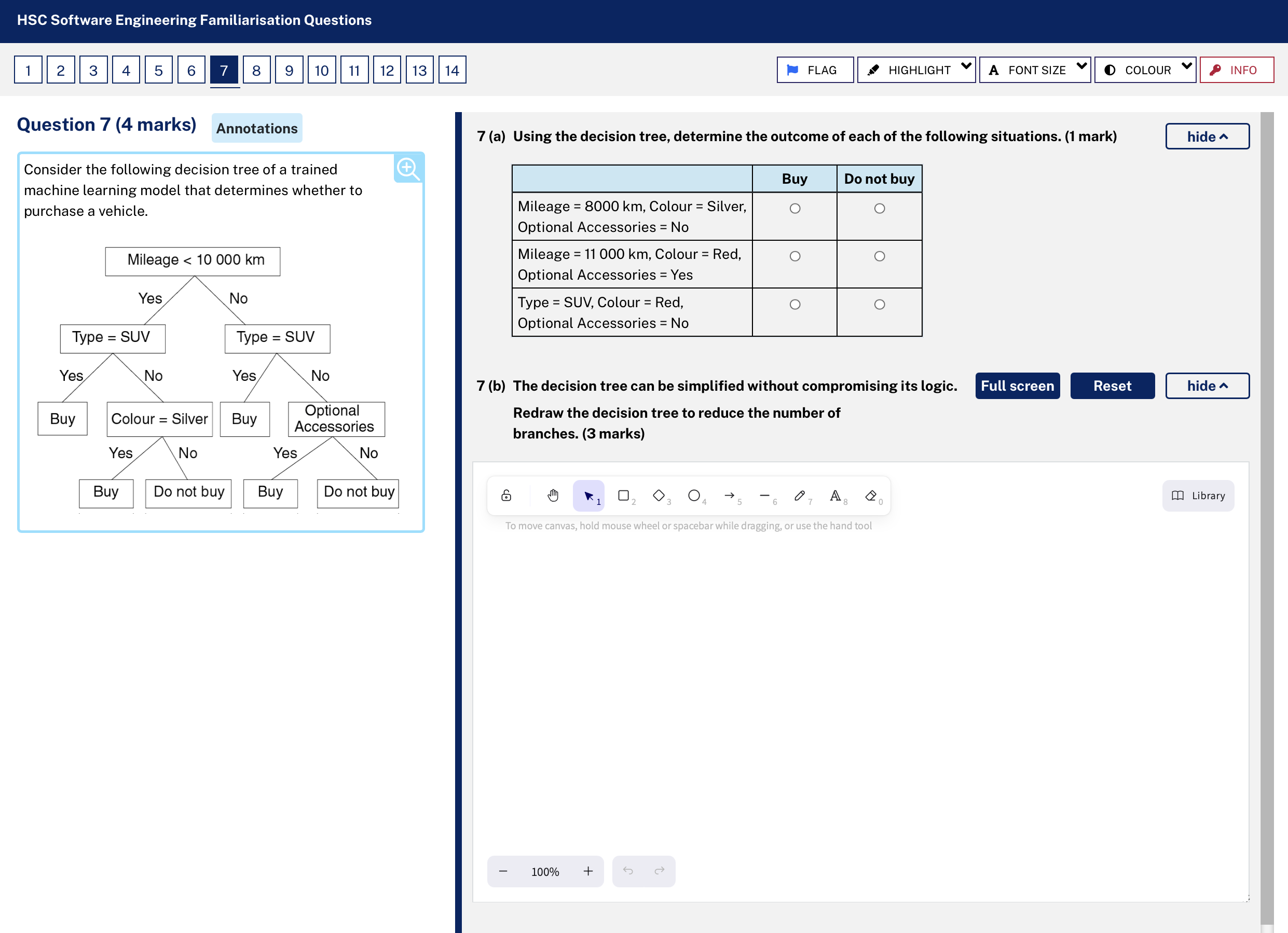
Part (a) 1 mark
Using the decision tree, determine the outcome of each of the following situations.
| Buy | Do not buy | |
|---|---|---|
| Mileage = 8000 km, Colour = Silver, Optional Accessories = No | ||
| Mileage = 11 000 km, Colour = Red, Optional Accessories = Yes | ||
| Type = SUV, Colour = Red, Optional Accessories = No |
Part (b) 3 marks
The decision tree can be simplified without compromising its logic. Redraw the decision tree to reduce the number of branches.
Reveal answer
Part (a)
| Situation | Outcome |
|---|---|
| Mileage = 8000 km, Colour = Silver, Optional Accessories = No | Buy |
| Mileage = 11 000 km, Colour = Red, Optional Accessories = Yes | Buy |
| Type = SUV, Colour = Red, Optional Accessories = No | Buy |
Part (b)
A simplified tree can first test Type = SUV. If yes, the outcome is Buy. If no,
test Mileage < 10 000 km. For lower mileage, test Colour = Silver; for higher
mileage, test Optional Accessories. These retain the original outcomes with fewer
repeated branches.
Marking rubric
Part (a)
| Marks | Description |
|---|---|
| 1 | Correctly determines the outcomes from the decision tree. |
Part (b)
| Marks | Description |
|---|---|
| 3 | Redraws an equivalent simplified decision tree with fewer branches. |
| 2 | Redraws a mostly correct simplified decision tree. |
| 1 | Shows some understanding of the tree logic. |
Explanation
Branches that always lead to the same result can be moved earlier in the tree to reduce repeated tests.
Metadata
- Submitter
- Seed data
- Created
- 2026-05-02
- Status
- published
- Syllabus
- y12-auto-ml-models y12-project-modelling-tools
- Tags
- decision trees machine learning simplification diagrams